Poster presentations are evaluated each semester by faculty, graduate student, and postdoctoral scholar raters against undergraduate research learning outcomes identified by the OUR. The purpose of these evaluations is to evaluate learning outcomes, and, sometimes to also determine poster prizes.
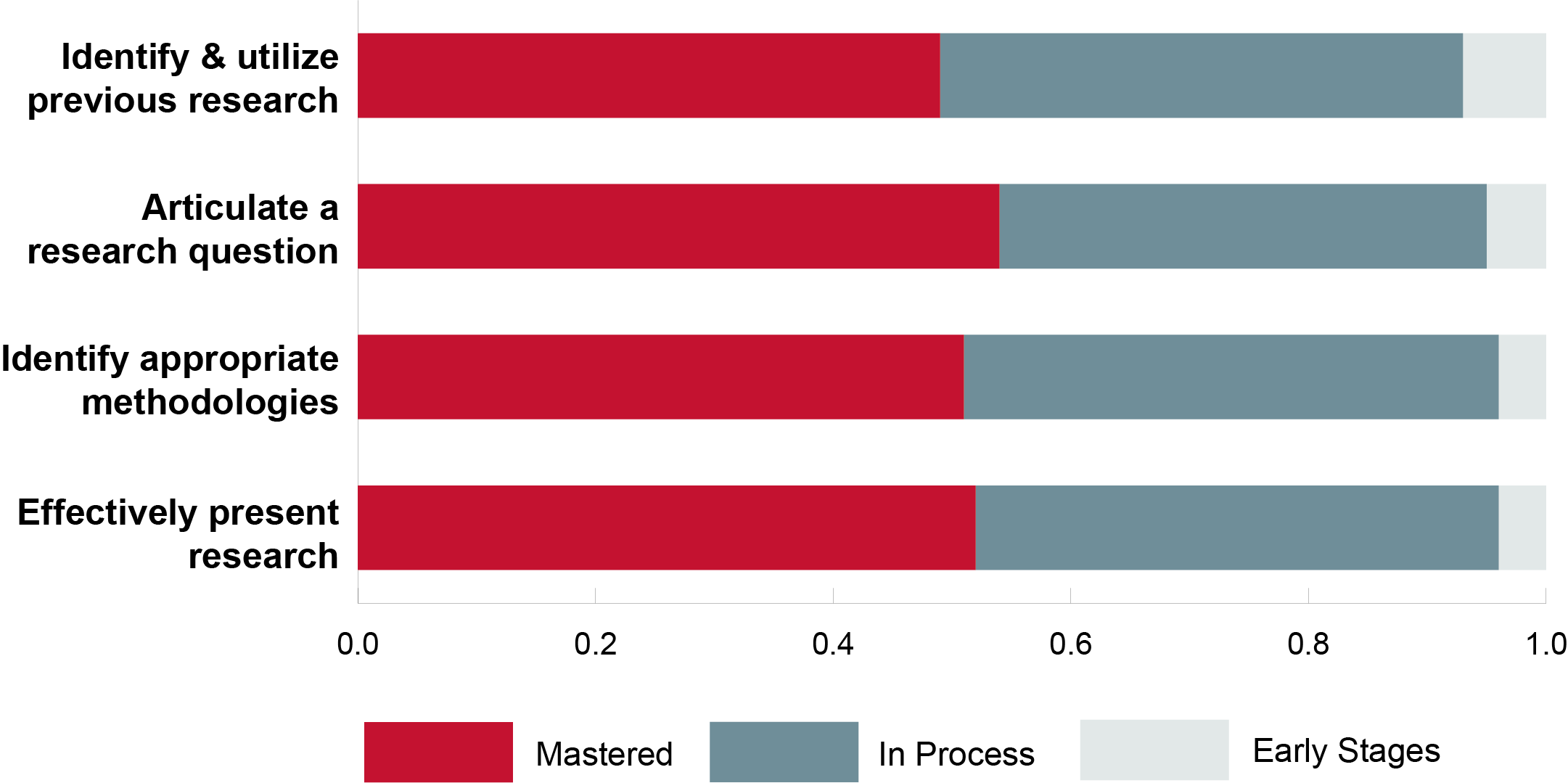
All posters are scored using the following Likert scale for the below questions:
- Score 0-5 - is in the earliest stages of development in this category
- Score 6-10 - is developing in this category
- Score 11-15 - is satisfactory in this category
- Score 16-20 - is above average in this category
- Score 21-25 - has mastered this category
- Engagement with scholarship and/or creative histories in the field
- Provides understanding of history of the field/creative contributions
- Identifies the novel contribution of the present work
- Articulates a timely and important research question or creative objective
- Explicitly states and explains the research question or creative objective
- The research question or creative objective builds on previous work cited
- Uses appropriate methodologies
- Clearly explains methods
- Acknowledges limitations of the methods used
- Clearly presents results
- Explicitly interprets results
- Presents the research effectively in a poster format
- Poster display is well-organized
- Tables, figures or images present content effectively
- Poster aesthetic captures and maintains viewer’s attention
- Research fosters societal impact
- Strong detailing of the role of the impact the research has on community (Utah or elsewhere) through visuals / text.
- Visuals / Text illuminate how the research will have a positive impact on people, communities, and the broader society.
- Excellent use of citations and literature review
- Provides a QR code to a full citation/bibliography document or webpage.
- Strong use of citation and literature accurately cites research using field standards (APA, MLA, Chicago, or ASA).
- Strong use of citation shows a diversity of citations - scholarly, non-scholarly, journal and book diversity.
- Excellent research narrative
- Strong writing style that concisely and clearly tells the research story
- Effective communication of research development, results, and findings to nonexperts.
- Excellent use of poster visuals
- Effective and meaningful use of layout, colors, typeface, icons, images, and graphics.
- Balance between visuals, text, and negative space.
- Visuals support and augment the research report.
Below are the evaluation results of the 2024-2025 symposia undergraduate presenters.