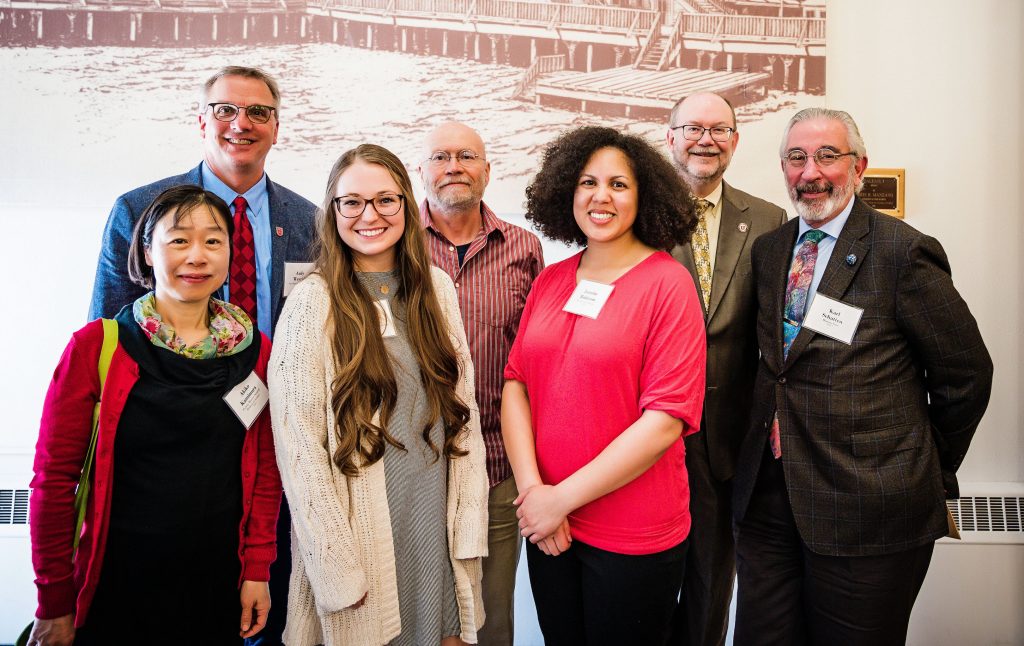
2024 Monson Prize Awardee
Pablo Cruz-Ayala (Prof. John Erickson)
NON-OBJECTIVE AND SUBJECT MATTER DEPENDENT VISUAL STIMULUS IN ARTWORK: INVESTIGATING ACCESSIBLE ART THERAPIES FOR VULNERABLE POPULATIONS
This study investigates the impact of art-based interventions on heart rate variability (HRV) and emotional regulation among undocumented immigrant populations. Utilizing a community-based participatory research (CBPR) approach, objective and non-objective artworks were presented in a public gallery setting. Pulse oximetry wearable devices were employed for HRV analysis. Results show a statistically significant improvement in HRV among participants exposed to immigrant subject matter-based artwork, suggesting the potential of art-based therapies for emotional regulation. Despite limitations in sample size and ethnic diversity, these findings contribute to the literature on art therapy.
2023
Malea Bauer (Prof. Amos Guiora)
SILENCE IS VIOLENCE: A NATIONAL LEGISLATIVE PROPOSAL FOR THE CRIMINALIZATION OF THE ENABLER TO INSTITUTIONAL ABUSE
For centuries, institutions have exploited their power to abuse the vulnerable and avoid culpability. In many cases, the abuse would not have been possible if not for the institutional underpinnings which protect the perpetrators. These people, who initiate cover ups or turn a blind eye, ought to be considered enablers. Enablers are as endemic a problem as perpetrators. This thesis advocates for establishing a federal duty to protect between members of institutions and the victims of institutional abuse. The proposed legislation defines an institutional duty to protect and criminalizes the actions or inactions of enablers that can be directly linked to continued abuse of the victims.
2022
Kassie John (Prof. Elpitha Tsoutsounakis)
DINÉ BIZAAD LANGUAGE CUBES: EXAMINING THE REFORMATION OF INDIGENOUS LANGUAGE PRESERVATION
Language is key to understanding cultural values and imperative sustaining a community’s cultural identity. Diné Bizaad Language Cubes explore ways to redesign how the Diné language is taught and preserved for my Diné. This design research project was an opportunity to ‘protect’ my Indigeneity (ways I identify as an Indigenous person) and to help ‘contain’ the Diné language for future generations to come. Diné Bizaad Sound Cubes is a tool for Diné youth and their communities to initiate their own “play” while aiding in the development of initial phonemes with Diné Bizaad pronunciation, reclaiming our pre-colonial ways of language acquisition through oral teachings.
2021
Cloe Butler (Prof. Ana Antunes)
"IDENTITY: BY KIDS, FOR KIDS" A STUDENT-CENTERED ZINE
My research tackles the inequities that immigrants and refugees face with accessing information about sexuality. I compiled personal definitions of sexuality topics and artwork from the kids at Sunnyvale Neighborhood Center into a Zine to be printed and distributed to the kids, SNC, and local libraries. Not only does the Zine include concepts explained by the kids themselves, but it prompts the youth to look further into sexuality topics. This project is a collaborative effort between the students and myself to produce a piece of work that will be shared with their peers. It will expand the knowledge around sexuality to kids that are not part of our program and incite social justice.
Jamie Goetz (Prof. Jeff Rose)
NATIONAL PARKS, A STORY OF COLONIZATION AND OUR RELATIONSHIP WITH THE LAND

National Parks are commonly positioned as the peak of "wilderness" conservation. However, they fail to acknowledge their violent histories of colonialism and imperialism on Indigneous peoples. Consequently, western models of land management and conservation are based upon principles of colonialism, capitalism, imperialism, and patriarchy, rather than place-based frameworks that are characteristic of Indigenous worldviews. This research concludes by presenting National Parks as central in Indigenous efforts toward decolonizing the settler, capitalistic views of environmental conservation and contemporary land management through actionable decolonial measures.